
A direct booking system for the independent garage

How we designed and built AutoBook, software that captures garage bookings from a workshop's own website, missed calls, and MOT reminders without paying marketplace commission.

Independent garages lose work to marketplace platforms that charge them for every job they win. AutoBook is the alternative. A booking page, a diary, and a quiet reminder loop, all running on the garage's own brand, with one flat monthly fee instead of commission on every booking.

The brief was a complete one. Build the product end to end. Brand, marketing site, customer booking flow, garage-facing diary, MOT reminder loop, and an optional AI phone capture layer. It had to feel premium enough that an owner would swap out their existing marketplace listing, and the build had to hold from a single-bay workshop up to a multi-bay centre without re-architecting halfway.

"More booked jobs. No marketplace fees." The single promise that anchored every product and design decision

Starting from the problem the trade actually has

Garage owners we spoke to weren't short on demand. They were short on margin. The dominant booking marketplaces charge per lead or per job, which means every time a customer found them online, the workshop paid for the privilege of doing the work. Direct bookings exist in theory, but most garages don't have a booking page worth sending traffic to, and the moment a customer searches "MOT near me", a marketplace listing outranks them in their own town.

AutoBook had to do two things at once. Give the workshop a direct route that feels as easy as a marketplace from the customer's side, and surround it with the small admin loops that make a customer come back next year without anyone in the workshop having to remember.
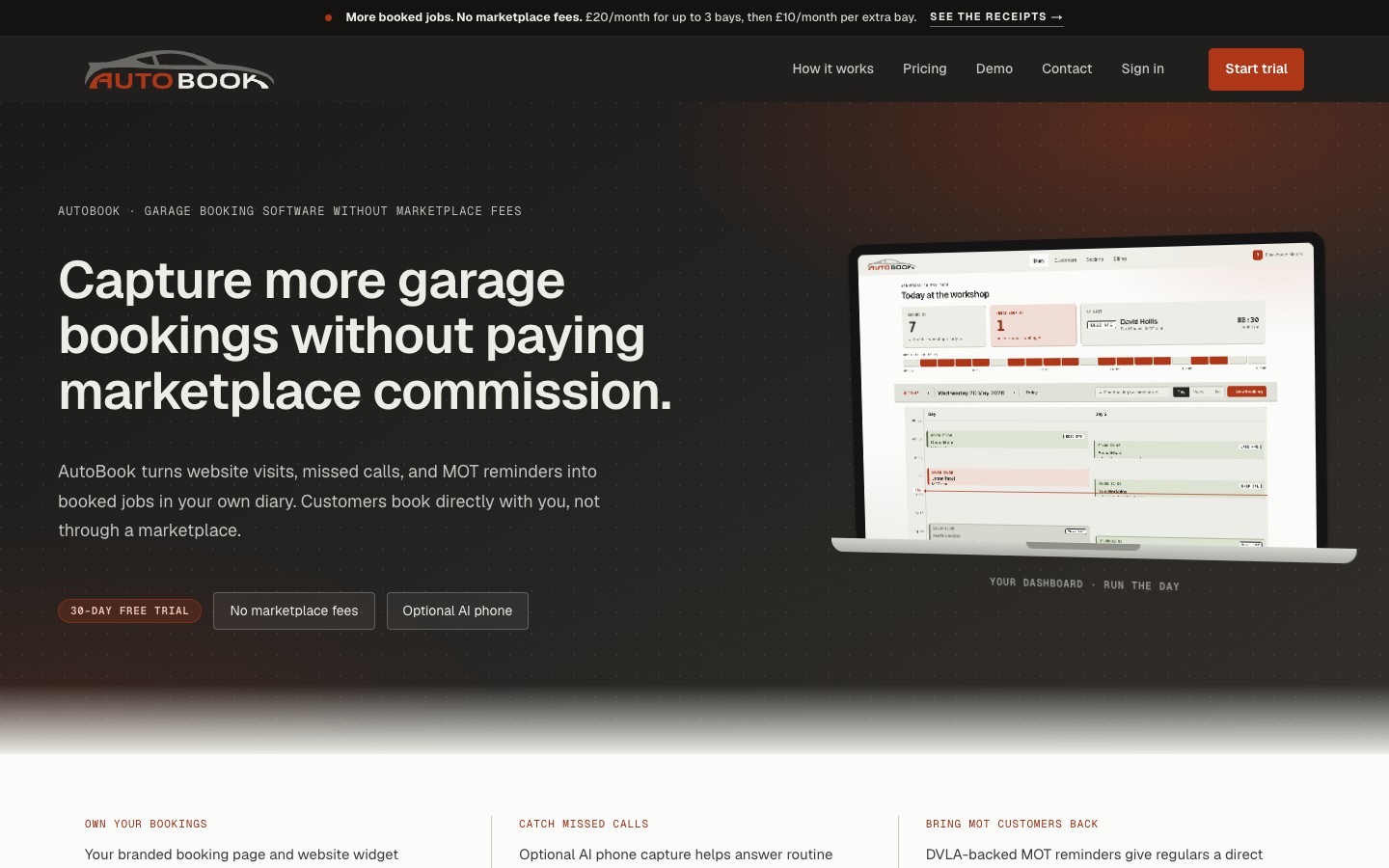
AutoBook homepage with dark workshop palette, copper-orange accents, the headline 'Capture more garage bookings without paying marketplace commission', and a laptop showing the garage diary

The brand

The visual direction came out of one observation. SaaS booking products almost always lean clean, friendly, and pastel. Garages don't. So we built a brand that looks like a workshop. Dark base, brushed metal greys, a single copper-orange accent for action, and a typeface heavy enough to read across a phone in a noisy bay.

The wordmark sets the tone. An open hood silhouette resolves into the "A" of AUTO, and the type sits flat and confident, the way signage does on the front of a real workshop. Photography direction follows through. Mechanics on the tools, brick walls, real bays. Stock-free, and on purpose.

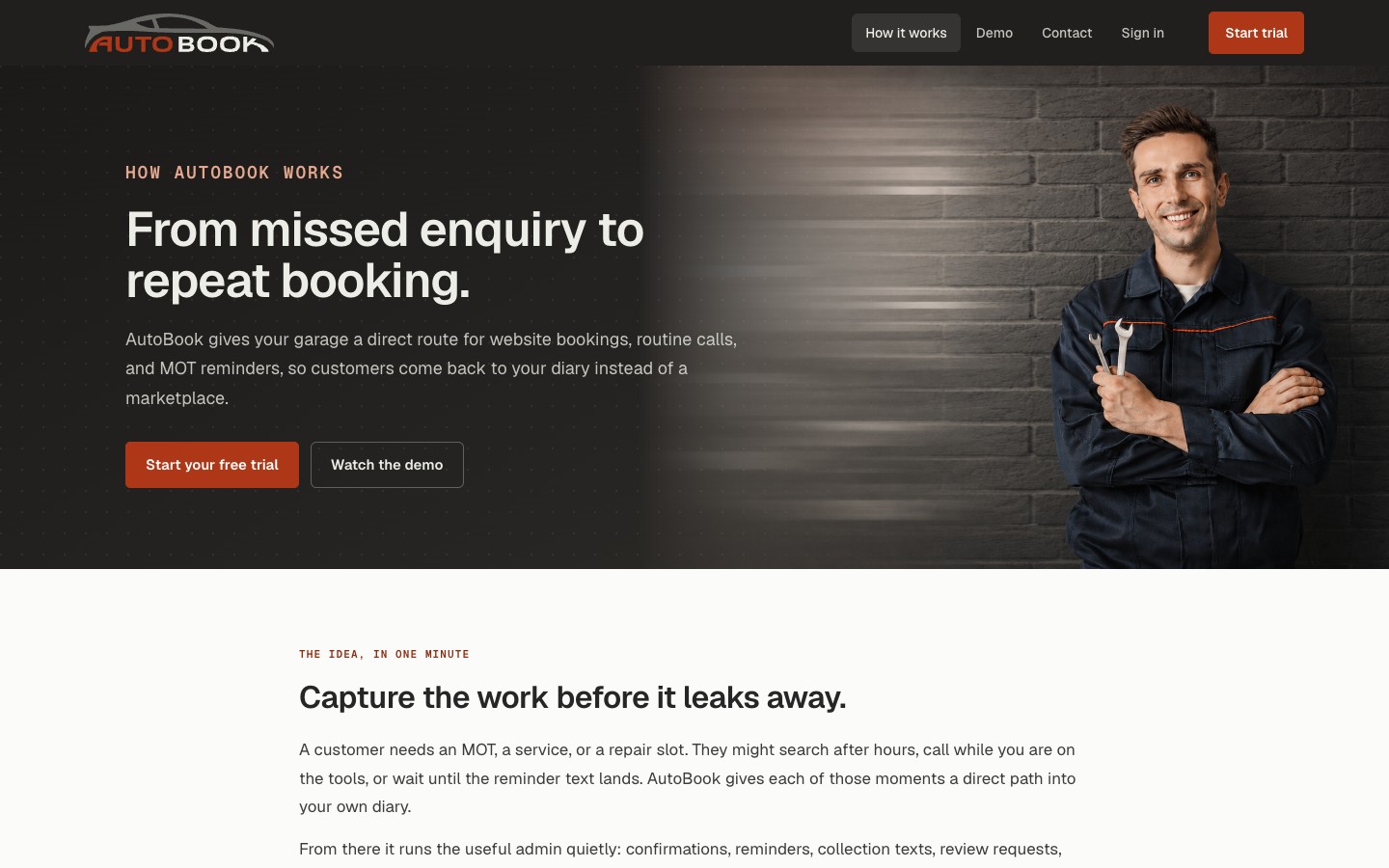
AutoBook how it works hero with the headline 'From missed enquiry to repeat booking' next to a portrait of a mechanic in front of a brick workshop wall

The customer booking flow

A customer arrives at a garage's AutoBook page from Google, Facebook, a text reminder, or a sticker on a van. They type in their reg, AutoBook looks up the vehicle against DVLA, the garage's services and prices appear filtered to that vehicle, and the customer picks a slot the workshop actually has free. No call back, no marketplace handoff, no fee on the way through.

Behind that simple flow, the booking page is a configurable layer the workshop owns. Their name, their services, their prices, their colours, their opening hours, and the number of jobs they can take a day. The page goes live the same afternoon the garage signs up.

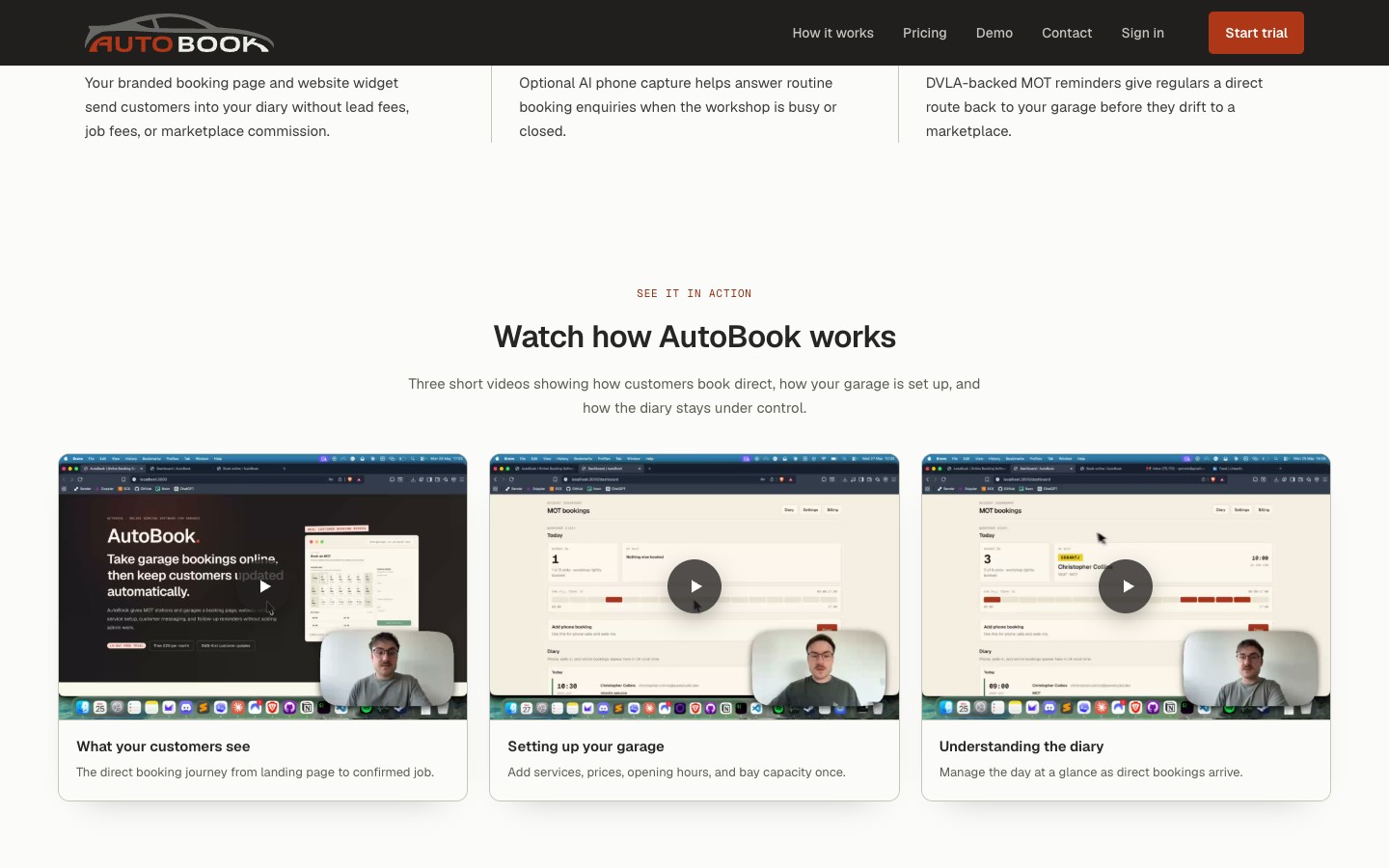
AutoBook product features section with three columns 'Own your bookings', 'Catch missed calls', and 'Bring MOT customers back', plus three video tutorials underneath

The garage diary

The garage-side of AutoBook is a single screen the front desk can run the day from. Today's bookings down the left, bay capacity across the top, and a clear visual of the day's load so an owner can see at a glance whether there's room to slot in a walk-in. New bookings drop in live as customers confirm. Late cancellations open the slot back up automatically so it can be filled rather than sit empty.

The diary is the part of the product the team actually lives in, so the design budget went into the small frictions. Re-assigning a job to a different bay is a drag. Marking a customer as a no-show writes the note into their record. Pulling up a vehicle history takes one click. None of it is novel on its own; the choice was to make every common action take less time than it does in the spreadsheet most workshops still run alongside their marketplace listings.

The MOT reminder loop

MOTs are the most predictable repeat business a garage has. Every car that comes through for one is due back next year, almost to the day. AutoBook reads MOT expiry dates from DVLA, schedules a text reminder window that lands ahead of the marketplace nudges, and sends the customer straight to the workshop's own booking page rather than back to a comparison site.

This was the bit the owners we spoke to cared about most. The marketplaces had effectively been farming each workshop's own customer list back to them every year. AutoBook closes that loop quietly in the background.

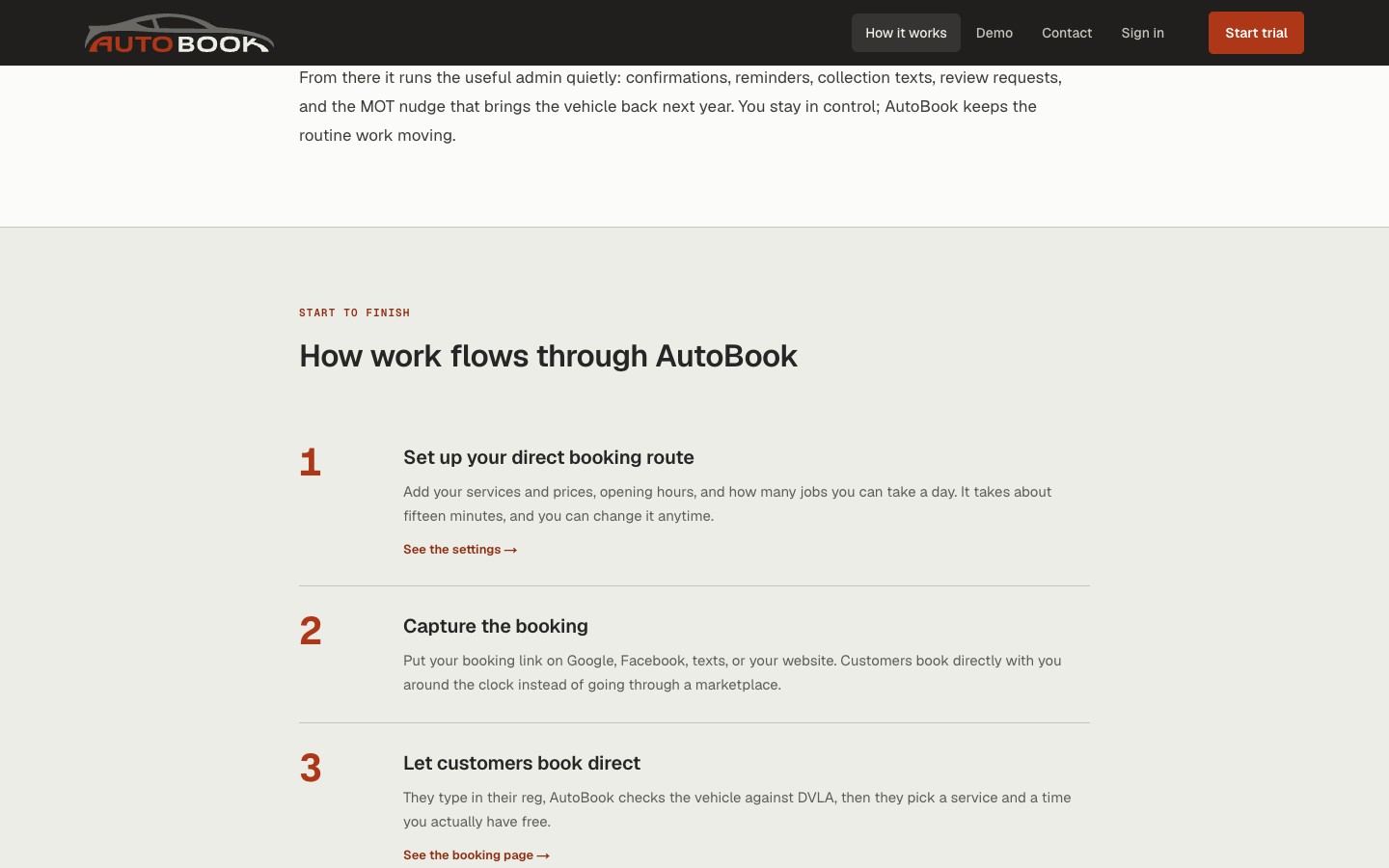
AutoBook 'How work flows through AutoBook' numbered steps explaining setup, booking capture, and direct customer booking

AI phone capture, as an optional layer

A lot of garage enquiries still come in by phone, and a lot of those calls hit voicemail because the team is on the tools. AutoBook offers an AI phone receptionist that takes routine booking calls when the workshop is busy or closed, asks for the same details the booking page asks for, and drops the result into the diary as a pending booking the office can confirm.

It was built as an add-on rather than a default. Some garages want every call to ring through to a human. Others want everything outside opening hours handled the same way the booking page handles a tap on Google. The architecture lets each garage make that call.

Pricing that's actually different

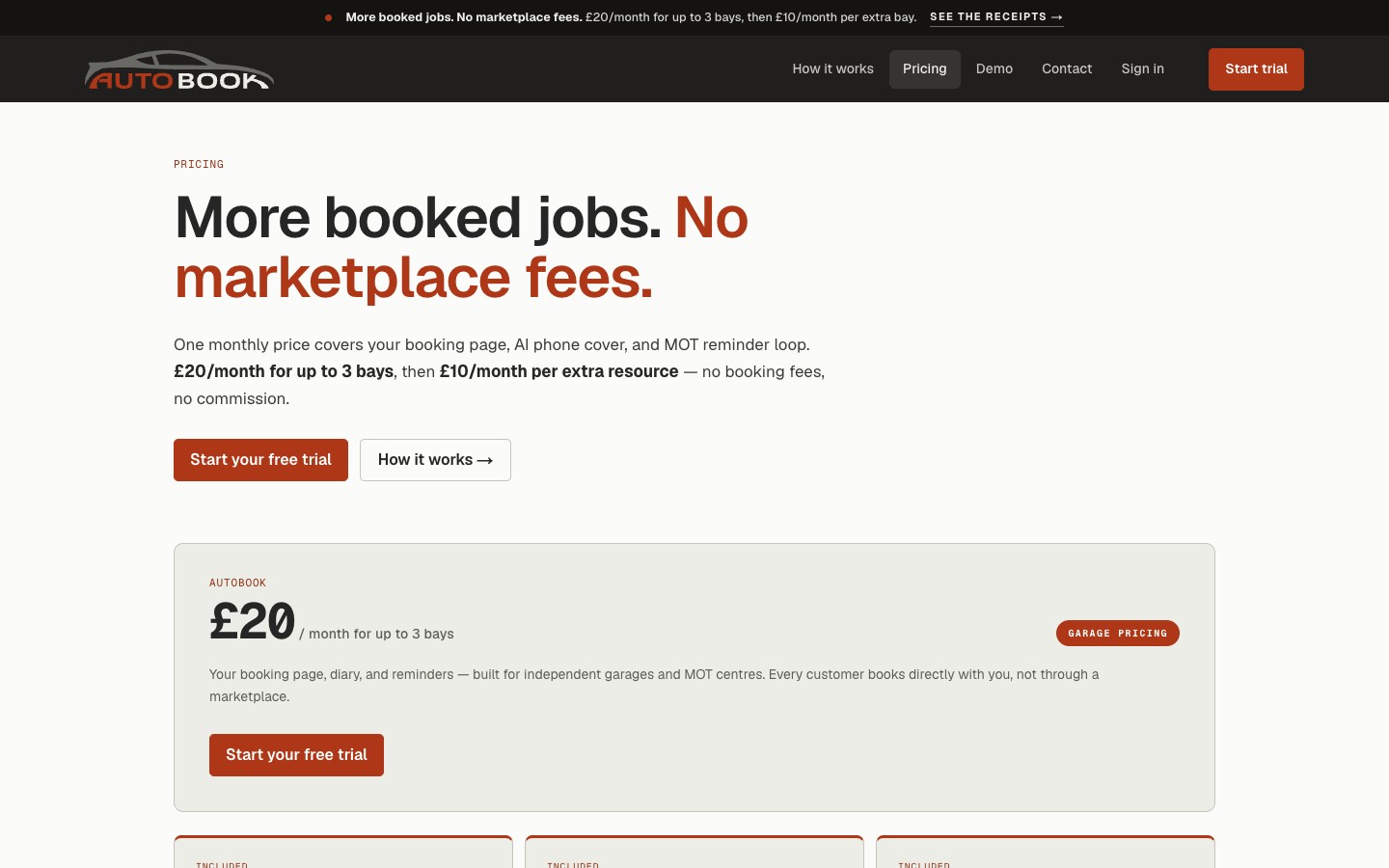
The product has to be priced the way the brand promises. AutoBook is £20 a month for up to three bays, then £10 a month per extra bay. There is no booking fee, no per-job commission, and no charge for using the AI phone receptionist beyond the standard usage cost. The pricing page exists less to sell and more to prove. It lays out the maths against the marketplaces a workshop is most likely to be on, with the numbers a garage can check against their own statement.

AutoBook pricing page with the headline 'More booked jobs. No marketplace fees.' and a pricing card explaining the flat monthly price

What was delivered

  • Brand identity, name, wordmark, typography, palette, and photography direction
  • Marketing site covering home, how it works, pricing, demo, and contact
  • Customer-facing booking page with DVLA reg lookup, service catalogue, and slot picking
  • Garage diary with bays, drag-to-rebook, no-show handling, and live booking confirmations
  • DVLA-backed MOT reminder loop with templated text messaging and direct booking links
  • Optional AI phone receptionist for routine booking calls outside the workshop's capacity
  • Flat-fee pricing model with no per-job commission, plus a comparison page against the marketplaces
  • Self-service onboarding flow that takes a workshop from signup to a live booking page inside an afternoon

The takeaway

The job wasn't to ship another SaaS booking tool. It was to give independent garages back the route to their own customers. The brand had to look like the trade, the product had to fit the way a workshop actually runs, and the pricing had to make the maths obvious. AutoBook is now live at autobook.uk, taking direct bookings for garages that no longer pay a marketplace for the privilege.

Brand, build, and
launch.

If you have a product idea that needs both a design system and the engineering behind it, we'd like to hear about it.

Get in touch